
The Four Pillars of Trust: Why Visibility Without Trust Will Not Grow Your Service Business
You are not here because you stopped trying. You are here because you kept going, and it has still not produced what it should.
The content is going out. The website exists. You show up, probably more consistently than most people in your industry. And on the surface, from the outside, it looks like you are doing everything right.
But the enquiries are not consistent. The right clients are not finding you with the regularity your effort deserves. And every time you have tried to fix this by doing more, posting more, switching platforms, the picture has not changed in the way you hoped.
This is one of the most common and most frustrating positions an established service provider can find themselves in. And it is almost never caused by what people assume it is caused by.
It is not a visibility problem. It is a trust problem.
The free quiz takes five minutes and tells you specifically which of the four trust pillars needs your attention first. Your result goes straight to your inbox.
Find out where your business stands.
The difference between those two things is the most important distinction in marketing that most service providers have never been clearly shown. And once you understand it, the reason the effort has not been converting becomes much easier to see.

Visibility and trust are not the same thing
Most marketing advice is built around a single premise. Get seen more and more and people will buy from you. Show up consistently, grow your following, post on the right platforms, and the enquiries will follow.
This is not wrong. But it is incomplete. And the gap between getting seen more and building enough trust to convert is where years of good effort can quietly disappear.
If you want to understand what your social media is actually capable of doing commercially, What Is Your Business Actually Missing Out On covers this in practice with two real business examples.
Visibility creates familiarity. Familiarity is useful. But it is not the same as trust.
Think about the businesses you follow online but have never bought from, and probably never will. You know who they are. You recognise their content when it appears in your feed. You might even find it valuable. But you do not yet trust them enough to spend money with them, or you do not have a clear enough picture of what they do to know whether it is relevant to you.
That is visibility without trust. Activity without conversion. And from the inside, it can look exactly like doing everything right.
Trust is built differently. It develops through patterns a potential client observes over time, often without realising they are doing it. Someone considering working with you is rarely making a decision in a single moment. They are watching. They may find you through a post in a group, come across a recommendation from someone they respect, then end up on your website a month later. Each of those moments is quietly answering questions:
Do I understand what this person does?
Is their message consistent?
Do they seem credible and straightforward?
Would I trust them with my business?
By the time they make contact, most of that judgement has already been made. Your marketing has been building or eroding that trust long before any conversation takes place.
What structured research in business communities revealed
The Four Pillars of Trust framework was not developed in theory. It was built from evidence.
I spent time running structured discussions in online business communities, asking established service providers direct questions about how they communicate their value. The conversations were designed to examine one specific thing, How clearly are service providers explaining what their business actually does.
The pattern that emerged was consistent and significant.
When asked why someone should choose their business, the majority of owners did not describe outcomes. They described feelings, motivations and aspirations. Responses such as empowering women through education and support, helping people feel less lonely, and my product has lots of uses appeared repeatedly.
These answers reflect genuine passion for the work. They do not reflect a message a cold audience can act on.
If someone landing on your website or social media cannot quickly understand what you do, who you help, and what problem you solve, they cannot form a reliable picture of your business. And without a reliable picture, they cannot trust that you are the right person for them.
The gap between what you intend to communicate and what a stranger actually receives is where trust quietly breaks down. Not through any failure of effort or commitment. The difficulty is that you cannot see your own business the way a cold audience does. You are too close to it.
That is a structural problem. And structural problems are the kind that do not resolve themselves through more activity.
Here is what that gap looks like from the buyer side.
Recently I was booking car hire. I had a discount code that was supposed to make booking online significantly cheaper. I worked through every step, added what I needed, and arrived at the total. It was more expensive than every other company I had compared for the same request.
The code was supposed to apply automatically. It had not. The saving that was the reason for booking through this particular company was not there.
I had used them before. I knew the quality was good. But that knowledge was not enough to overcome what the system had just told me about how the experience of working with them would feel. If the promise did not hold at the point of booking, before any money had changed hands, what would it look like once it had.
I booked elsewhere. A company I had not used before but whose pricing was transparent, whose inclusions were clear, and whose system did exactly what it said it would do at every step.
That is how quickly trust forms and how quickly it breaks. Not in dramatic moments. In the small experience of whether a business does what it says it will do, before the relationship has even properly begun.
Your potential clients are having exactly this experience when they encounter your business. Not necessarily with pricing. But in the small moments where what they expected to find and what they actually found did not quite match. And most of the time you will never know it happened.
The Four Pillars of Trust and what they mean for your business
Trust in business visibility is not a single thing. It is an outcome produced by four things working together consistently. When all four are present, a cold audience begins to form the kind of clear and reliable picture of a business that eventually becomes a conversation. When one or more is missing, the effort being put into visibility does not convert the way it should.
These four things are the pillars that underpin every service at The Efficient Penguin Co., and they are the lens through which every brand review is conducted. They are also the signals your potential clients are already evaluating, whether consciously or not, every time they encounter your business online.
The four pillars are:
Consistency
Transparency
Accountability
Reliability
Trust sits at the centre as the outcome of all four working together. Not one pillar in isolation. All four.
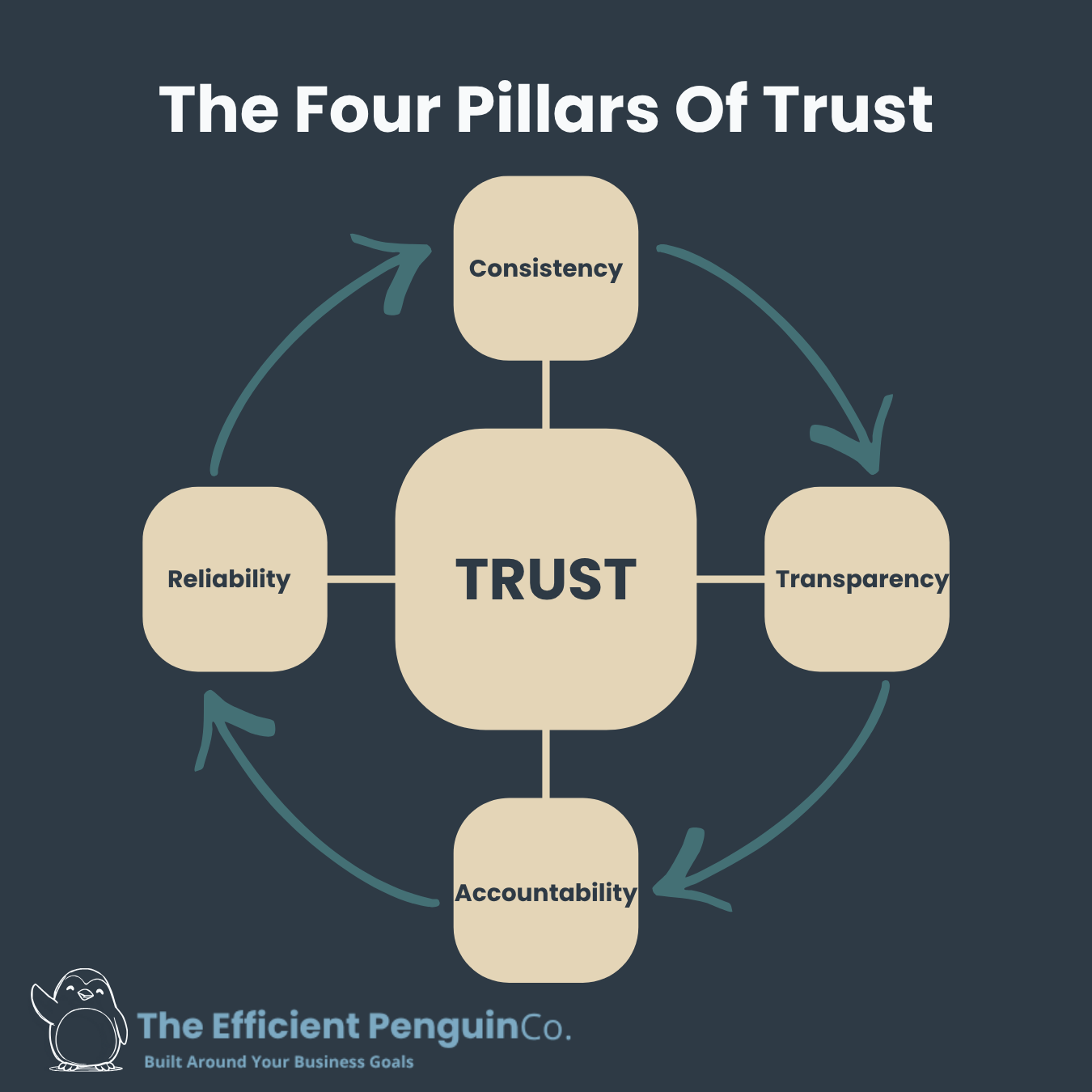
Pillar one: Consistency
Consistency is the pillar most service providers believe they already have, because they are posting regularly. That belief is understandable, but it mistakes frequency for something deeper.
The consistency that builds trust is about whether your message, your positioning, your tone and your identity are recognisably the same across every place a potential client encounters you. It is about whether someone who found you on Facebook last month would recognise the same business if they arrived at your website today, or came across you through a Google search next week.
When messaging shifts, even gradually and even with good reasons, something breaks in the picture a potential client is forming. They begin to feel uncertain about what you actually stand for. And uncertainty is the direct opposite of trust.
The service providers who build the strongest trust online are not always those who post the most. They are those whose message is coherent and recognisable enough that a potential client can form a reliable picture of the business from multiple touchpoints, without needing to do additional work to piece it together.
That picture is built through sustained consistency over time. It cannot be substituted with volume.
Pillar two: Transparency
Transparency is the pillar that separates businesses that look impressive from businesses that feel trustworthy. Those are not the same thing, and the people you are trying to reach know the difference.
The potential clients you want to attract are research-led. They have enough experience to know that polished copy and confident positioning do not always match the reality of working with someone. They have had at least one experience where that gap showed up in ways that cost them time, money or both. They are cautious for good reason, and that caution is not something a slicker website or a more frequent posting schedule will overcome.
What cuts through is transparency in how your business presents itself. Evidence that you communicate openly about how you work, what someone can expect from engaging with you, and how you think about the problems you solve. Not a performance of confidence. Actual openness.
When that transparency is present, it removes hesitation. It gives the right people the confidence to start a conversation before they have gathered every piece of proof they would ideally want. It signals that the reality of working with you matches what you say publicly.
Without it, uncertainty compounds quietly. And a research-led potential client sitting with compounding uncertainty rarely becomes an enquiry.

Pillar three: Accountability
Accountability is the pillar most businesses overlook, because it requires an honesty that feels uncomfortable. Looking at what your marketing is actually producing, not what you hoped it would produce, and adjusting based on what the evidence shows.
This is a principle that comes directly from professional investigation and quality assurance work. You follow the evidence. You do not continue with an approach because you have invested time in it. You do not dismiss findings because they are inconvenient. You adjust based on what is actually happening, not what you assumed would happen.
Applied to marketing, this discipline produces better decisions and stronger results over time. But for the potential client observing your business from the outside, accountability also shows up as credibility. It signals that you are someone who takes results seriously, reviews your own work honestly, and improves. That signal matters significantly to a cautious buyer who has previously worked with someone who did not.
Accountability is not about publicly acknowledging what is not working. It is about demonstrating, through how your business communicates and evolves, that you are genuinely committed to outcomes rather than to the appearance of activity.
Pillar four: Reliability
Reliability is the pillar that converts everything else into action.
A potential client can have a clear and consistent picture of your business, feel reassured by your transparency, and trust that you take your work seriously. But if they carry any doubt about whether you will actually follow through, they will still hesitate.
For the cautious, research-led buyer that most established service providers are trying to reach, previous experience of unreliable suppliers is almost always part of their history. They have waited longer than they were told. They have had to chase for updates. They have had to manage a supplier who turned out to be less organised than they appeared. That experience does not disappear quickly. And it makes them very attentive to small signals.
Reliability shows up in ways that are easy to underestimate. Responding to a comment when you said you would. Delivering what you promised in a piece of content. Following through consistently on the processes and standards you describe publicly. Being present in a steady, dependable way over time rather than in bursts followed by silence.
Small signals, sustained over time, are the only reliable evidence of how someone will actually behave. Your potential clients know this. They are looking for those signals, even when they could not tell you that is what they are doing.
Why more activity will not fix a trust problem
The instinct, when visibility is not converting, is to do more. More content, more platforms, a new strategy, a different approach. This is understandable. It feels like action. And action feels better than sitting with a problem that does not have an obvious cause.
But more activity does not fix a trust problem. It amplifies whatever is already there. If the message is inconsistent, more content spreads that inconsistency further. If transparency is missing, more visibility exposes that gap more widely. If the foundations are not solid, more activity accelerates the leak rather than sealing it.
There are two questions worth separating here. The first is the one most service providers are asking. How do I get more visible. The second is the one that actually matters. Are the four pillars of trust present in how my business shows up online right now. Not in intention. In practice. As a cold audience would experience them.
Those are different questions. The second one is the useful one.
The same evaluation runs in both directions
There is a parallel here that is worth naming, because it changes how this framework lands.
The four pillars your potential clients use to evaluate whether to trust your business are the exact same signals you use when you are considering whether to trust a supplier. You look for a consistent, coherent message. You want to understand how they work and what to expect. You want evidence that they take results seriously and will follow through.
That is:
Consistency
Transparency
Accountability
Reliability
Your own evaluation process, whether you have named it that way or not.
Your potential clients are running exactly the same process every time they encounter your business. Understanding this shifts the central marketing question from how do I get more visible to what signals is my marketing actually sending, and are they building the kind of trust that converts.
Where to start with an honest assessment
The questions below are the starting point for understanding how the four pillars are currently showing up in your own business. They are not designed to produce a score or a rating. They are designed to help you see your business the way a cold audience does, not the way you see it from the inside.
Consistency. If someone encountered your business on three different platforms this week, would they form a coherent and consistent picture of what you do, who you help, and what makes you different? Or would they piece together three slightly different versions?
Transparency. Does your content and your website show how you think and how you work, or does it stay at the level of what you do rather than how and why? Would a cautious potential client feel more confident or more uncertain after spending ten minutes with what you have published?
Accountability. Does your marketing give any indication that you pay attention to what is working and adjust your approach accordingly? Or does it look like content going out on a schedule, disconnected from any clear evidence of what it is producing?
Reliability. Over the last three months, has your presence been consistent and dependable? Would someone who has been quietly observing you feel confident that you are someone who follows through?
The answers to these questions will tell you more about why your current level of visibility is or is not converting than any analysis of posting times, hashtag strategy or algorithm changes.
If those questions raised something specific, the free quiz gives you a scored answer across all five areas of your business. You do not need to work it out from the questions alone.
Trust is the outcome. The pillars are what build it.
The content in this blog series is built around a single conviction. Established service providers who are doing the right things deserve to see the results they have earned. The gap between the effort going in and the enquiries coming out is almost never caused by the things most people assume. It is almost always caused by one or more of these four pillars being weaker than the business owner realises, because it is genuinely hard to see from the inside.
When Consistency, Transparency, Accountability and Reliability are all working together, a cold audience begins to form the kind of reliable picture of a business that eventually becomes a conversation. And a conversation, with the right person, becomes a client.
More visibility does not create that picture. The foundations do.
If you want to see what becomes possible when the foundations are in place and a connected system sits behind the social media, What Your Business Could Be Earning That It Currently Is Not shows the commercial picture clearly.
Picture what it feels like when all four pillars are working together.
Not perfect. Not effortless. Business never is. But free from the second guessing that has been running quietly in the background of every decision you have made about your marketing. The constant questioning of whether the message is right, whether the content is landing, whether the platform is wrong, whether you should rewrite the bio again. That noise does not disappear overnight. But when the foundations are solid and the trust is building consistently across every touchpoint, something settles. You stop adjusting from uncertainty and start building from a position of knowing. The decisions get easier because there is something underneath them that holds. You put out a piece of content and you feel the difference between posting because something needs to go out and posting because you know it is right. That feeling, quiet and unglamorous as it sounds, is what the work of getting this right actually produces. Not just a stronger business. A clearer head. And the freedom that comes from finally trusting what you have built.
Do not give up. You have been working so hard at your business and you are moments away from something clicking and changing.
I saw a post on social media recently about people quitting before they hit the gold. The comments underneath were the part that stayed with me. People asking how do you know they missed out on the gold. And others replying because we were exactly there. We felt exactly what they felt in that moment. And then something shifted. They saw the light at the end of the tunnel.
That is not a motivational story. That is testimony from people who were in the tunnel and could not see how close they were. Who pushed through anyway and found out the breakthrough was closer than it felt.
The four pillars are not a quick fix. They are the work of building something that holds. But the business owner who keeps showing up, who makes the adjustments, who holds the standard even when the results are not yet visible, is the one who looks back and understands why it was worth pushing through.
Most people stop just before it changes.
You do not have to be one of them.
If this has raised questions about your own marketing, the next step is finding out how these four pillars are currently showing up across your specific business. Why Most Service Providers Struggle to Explain What They Do looks at one of the most common reasons trust does not build the way it should and is the natural next read from here.
If you would rather start with a structured look at how the pillars are showing up across your website, messaging and social presence, the Brand Alignment Audit applies this framework directly to your business and identifies, with evidence, what is working and where the gaps are.
If you are not yet sure where your foundations stand, the free quiz takes five minutes and gives you a specific, scored picture of exactly where your business is working and where it needs attention. Most people find at least one thing they did not expect.