
Content Planner for Social Media | Stop Posting Without a Plan
You Keep Showing Up. So Why Is Nothing Actually Moving?

You sit down on a Sunday evening to sort the week ahead. You open a blank document. You think about what to write. Something useful, something that sounds like you, something that will actually land with the right people.
An hour later you have a caption. It is good. You know your subject and it shows. You schedule it and close the laptop.
Monday morning it goes out. A few likes from people you already know. A polite comment from someone in your network. And then the feed moves on, and so does everything else, and by Thursday you are back at the blank document doing the whole thing again.
You have been doing this for months. The effort is real. The quality is real. The consistency is real.
And yet at the end of most months you still cannot honestly answer the one question that matters.
Is any of this actually moving my business forward?
The thing you have already tried
When the results do not match the effort, the instinct is to change something visible. The platform. The format. The frequency. Maybe Instagram instead of LinkedIn. Maybe video instead of graphics. Maybe three times a week instead of five.
So you try it. And the result is the same. Because none of those things were the problem.
The problem is that consistent posting and strategic content planning are two completely different things. And almost every social media plan template, social media marketing plan template, content calendar, and scheduling tool available treats them as if they are the same.
A content calendar tells you when to post. It does not tell you whether what you are posting is connected to a business goal, whether it is reaching the right person at the right point in their thinking, or whether the hours you are putting into it are returning anything worth returning. It just keeps you filling the slots.
Not sure whether your content planning is the main gap or whether something else needs attention first? The free quiz takes five minutes and tells you specifically where to focus.
Find out where your business stands.
So the content keeps going out because stopping feels worse than continuing. And the Sunday evening blank document keeps appearing. And the question of whether any of it is actually working stays quietly, persistently unanswered.
What that gap is actually costing you
Here is the specific cost of content without a plan behind it.
You publish a post. It performs reasonably well. You make a mental note to do more of that. But reasonably well on a platform means nothing if you cannot connect it to an enquiry, a conversation, or a decision. The post did something. You just do not know what.
You publish another post the following week. It gets almost no engagement. You make a mental note to avoid that topic. The reason it did not land might have had nothing to do with the topic or the format. It might have been the wrong message for where your audience was that week, or the wrong type of content for where they are in their thinking about working with you. Without a structured way to assess that, you are drawing conclusions from incomplete evidence. And those conclusions quietly shape what you keep doing and what you stop doing, month after month, without any of it being grounded in what is actually true.
Meanwhile the decision about whether to keep managing your own content, or whether that time belongs somewhere else entirely, stays permanently on hold. Because you cannot make that decision from instinct. You can only make it accurately when you know what your content actually costs you in time and what it is actually producing in return.
Most established service providers review their finances. They audit their client processes. Very few ever sit down and look at their content as a body of work and ask what it has actually produced. Not because they do not care. Because they have never had a tool that was built to answer that question properly.
If you want to know whether content strategy is your biggest gap right now, the free quiz gives you a scored result across five specific areas of your business in five minutes.
What changes when your content has a real plan behind it
Picture sitting down this Sunday evening with something different in front of you.
Before you write a word, you already know why this post needs to exist. You know who specifically is going to read it and where they are in their thinking about working with you. You know whether this person needs to be educated, reassured, or moved closer to a decision. You know exactly what the post is trying to do from a business perspective before you write the first sentence.
You finish in half the time. The decisions were already made before you opened the document. The writing is the execution, nothing more.
A month from now, you sit down to plan the next cycle of content and you open a structured record of everything that went out. You can see which posts connected to a business objective and which did not. You can see which ones took forty minutes and which ones took two and a half hours. You can see a pattern in what landed and what disappeared. You are not guessing. You are reading evidence.
Three months from now, an enquiry arrives from someone who has been reading your content for weeks. They already understand what you do. They already trust how you think. They are not starting the conversation from scratch. They arrived warm because the content they read was doing a specific job, consistently, in the right direction.
That is what content looks like when it is connected to a strategy. The effort does not change. The intention behind it does. And that intention, applied consistently over time, is what turns a content feed into something that actually builds.

Why I built this, and what that means for you
I spent 12.5 years in professional investigation and evidence gathering, followed by 18 months in leadership and quality assurance. The core of that work was always the same. You do not draw conclusions until you have looked at what the evidence is actually showing you. You do not go on instinct when you have access to data. You structure the information first, and then you let it tell you what it needs to tell you, even when that is not what you expected.
When I looked at how I was managing my own content, I applied the same discipline. And what the evidence showed me was this. I had no structured way of connecting what I was posting to what my business was trying to achieve. I was assessing what worked based on platform metrics that told me almost nothing useful. I had no honest picture of what my content was actually costing me in time. And I could not have handed my content process to anyone else because it lived entirely in my head.
I went looking for a content planner for social media that would fix that. What I found were basic social media plan templates with days of the week and empty boxes, or complicated systems built for marketing teams. Nothing was designed for an established service provider working alone who needed to know, specifically, what their content was doing and whether it was worth what it was costing.
So I built it myself. The Strategic Content Planner is that tool. Built on the same principle I applied for over a decade in professional investigation. Structure the data properly first. Then let the evidence tell you what is actually true.
Here is what that looks like in practice. When you sit down to plan a post in the planner, you are asked to identify the business objective before you write anything. Not a vague intention, a specific commercial connection. If you cannot make that connection, the planner shows you that before you spend an hour on a caption. That single question, asked consistently before every piece of content, surfaces something most service providers have never seen clearly. How much of what they are producing has no defined job to do. The answer is almost always more than they expected. And that is useful information, because you cannot improve something you cannot see.
What the Strategic Content Planner actually does
It is not a content calendar. It is not a scheduling tool or a caption writer.
It is a structured planning system that connects every piece of content you create to a specific business objective, a content pillar, and an audience need before you write a single word. And it tracks what that content costs you in time so you always know whether it is worth it.
If you have been looking for a way to understand how to plan social media content in a way that is directly connected to what your business is trying to achieve, this is what that looks like in practice. Not a social media plan sample that shows you another business's approach. A content strategy planner that builds your strategy around your specific goals, your specific audience, and your specific offers.
Every piece of content starts with a business objective. If you cannot make that connection, the planner tells you before you commit time to it. Every post is tracked for time so you know exactly what your content is costing you. Every post is reflected on so that over time you are building a structured picture of what is actually working rather than making decisions based on feel.
The result is content that is intentional rather than reactive. Connected to your business goals before it is written. Assessed against those goals after it goes out. And tracked in a way that makes every planning decision that follows it more accurate.
The number most people do not expect
Most content planner tools focus entirely on what you are going to create. The Strategic Content Planner also asks you to track how long it actually takes.
Not as pressure. As data.
Most service providers know their content takes time. What they have never done is measure it with any precision. They think of it as an hour here and there. When they start tracking estimated time against actual time per post, the real number appears. The hour that was actually two and a half. The quick graphic that became a Saturday morning. The caption that went through seven drafts before it felt right. Across a week, across a month, that number is almost always a surprise.
When you see it clearly, one of two things happens. Either you find ways to make the process significantly faster with proper structure, which is exactly what the planner is designed to support. Or you realise the time cost has quietly become unsustainable, and the decision you have been putting off stops feeling like a difficult one once the evidence is in front of you.
Both of those outcomes matter. The planner gives you the data to reach either conclusion honestly. If planning and posting consistently does not fit your time or your energy at this stage of your business, that is not a failure. That is a clear signal pointing toward the right next decision.
The difference between being the system and owning the system
One of the most consistent patterns among established service providers who want to grow is that everything about how their business communicates lives only in their head.
They know what they want to say. They know who they are talking to. They have a clear sense of the tone, the topics, the things they would never post. But none of it is written down in a format that anyone else could work from. Which means they are always the one sitting down on Sunday evening, regardless of how full everything else already is.
When your content planning lives in a structured tool, that changes. You complete the planner for your own business. Once it is done, a VA can work directly from what is mapped. The hook, the talking points, the CTA type, the platform, the format. It is all there. They can create the graphics and write the captions without needing a briefing call, a voice note, or you to be available. The strategy stays yours. The execution does not have to be.
There is a meaningful difference between being the system your business runs on and owning a system your business runs through. One of those is sustainable as the business grows. The other quietly limits everything.
What is inside
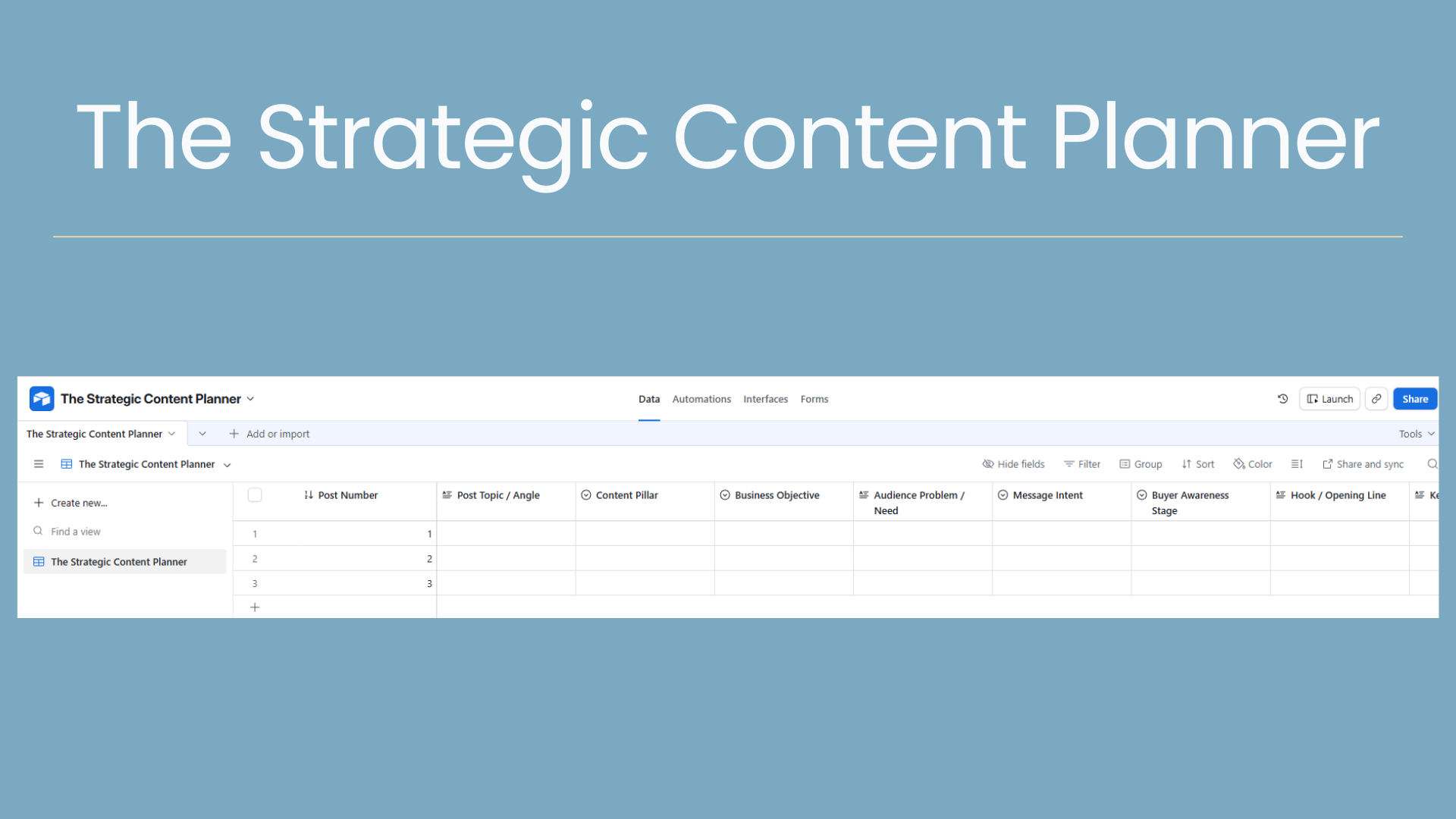
The Strategic Content Planner is a complete social media content planner and content strategy planner. Not a single content planner template. A full system with four components, each with a specific job.
The Airtable planning base is the core of the tool. Every post gets a structured home before you write a word. Business objective, content pillar, audience need, buyer awareness stage, hook, talking points, caption space, CTA type, platform, format, time tracking, and reflection prompts. All connected and mapped in advance so you know why you are creating each piece before you start creating it.
The 36-page PDF guide walks through every element of the planner, why each column exists, and how to read what the data is telling you. It is written as a reference document you return to as your content planning develops, not a one-time read that sits in a downloads folder.
The video walkthrough covers every element of the planner in action. If you learn better by watching than reading, the video shows you exactly how the system works before you use it yourself.
The illustrated setup guide provides step-by-step screenshots from a real Airtable account. No prior experience with Airtable is needed. Most people are using the planner within thirty minutes of purchase.
Total value £250. Your investment £49. One payment. Delivered immediately.
If you want the strategy built for you instead
The Strategic Content Planner gives you the framework to build and manage your own content strategy. For service providers who want the strategy designed around their specific business, goals, and offers rather than building it themselves, the 90-Day Direction Plan does that work for you.
The planner is where to start if you are ready to plan your own content with proper structure. The 90-Day Direction Plan is the natural next step if you decide you want it built for you.
Who this is designed for
The Strategic Content Planner is for established service providers who are already showing up and want to make that effort count for more.
It is for you if you post regularly but cannot connect what you post to a clear business objective. If you want to understand how to plan social media content ahead of time instead of deciding the night before. If you manage your own content and want to do it with more direction and significantly less decision fatigue each week. If you want something you can complete yourself and then hand to a VA so they can create graphics and captions without needing to come back to you at every step. If you want to know what your content is actually costing you in time. If you are not ready to invest in done-for-you strategy yet but want a proper framework rather than a blank page and a vague intention.
It is not for you if you want someone to write your captions, plan your graphics, or post for you. This tool structures your thinking. The thinking remains yours.
Your content deserves a plan behind it
You have already done the hard part. You have been sitting down on Sunday evenings and showing up anyway. The consistency has been there from the start.
The piece that has been missing is not more effort. It is a structure that makes your effort connect to something that builds rather than something that resets.
The content going out next month will either be planned with intention or produced reactively. The Strategic Content Planner is what determines which of those it is.
Get the Strategic Content Planner for £49
One payment. Delivered immediately. Airtable planning base, 36-page PDF guide, video walkthrough, illustrated setup guide.
At checkout, add the Content Audit Template for £17. It is a retrospective review of everything you have already published, so you are building the next cycle of content on what is already landing rather than starting from a blank page. Most people find it useful to run the audit first and then bring those findings into the planner.
Not sure whether content is actually your biggest gap right now. The free quiz looks at five areas of your business including your messaging, strategy, capacity, and foundations, and tells you exactly where to focus first. Most people find at least one thing they did not expect.