
What Is a Sales Funnel and How Do You Build One That Actually Works for Your Business?

You have heard the word. You have probably nodded along in a conversation where someone used it with complete confidence. You may have looked it up once, found a diagram covered in arrows and abstract stages, and closed the tab feeling no clearer about what it means for your business specifically.
That is not a gap in your understanding. It is a gap in how this subject is usually explained.
Most funnel content is written for marketers. It assumes familiarity with terminology that takes months to make sense of. This does not. This is written for an established service provider who has been building something real, showing up consistently, and wondering whether the system underneath all of that effort is actually working as hard as it should be.
I know that position well, because I was there too. When I first encountered the word funnel I had no idea what it meant. I looked into it. I became genuinely fascinated by how it worked, by the idea that a properly built system could keep a business selling and converting while the person running that business was doing something else entirely. That fascination led me to invest in learning properly through Charlotte Wibberley's CPD-accredited Certified Launch and Funnel Strategist programme, and in building properly, until eventually I became certified myself. Everything in this blog comes from that training, that process, and the work of building funnels grounded in strategy rather than assumption.
What is a sales funnel
Every business wants to make sales. The question is how those sales are generated and whether you need to be personally present at every stage of the process to make them happen.
Think about what you currently do to bring in work. You create content. You show up on social media. You have conversations. You follow up. You answer questions. You send proposals. Each of those steps requires something from you. Your time, your attention, your presence. And the moment you step away from any of them, the moment a client deadline arrives, life gets in the way, or you are simply exhausted, the pipeline slows. Sometimes it stops.

A sales funnel is the system that changes that.
It is a structured, connected sequence of steps that moves a potential client from discovering your business to making a decision about whether to work with you, with as much of that journey automated as possible. It runs in the background. It works without your direct involvement at every stage.
The goal is not to remove the human element from your business. It is to automate what can be automated so that your time and attention go to the parts of the business that genuinely need you, the delivery, the relationships, the decisions only you can make.
A properly built funnel is also evergreen. It runs continuously, not just when you are actively pushing it. It does not depend on you posting at the right moment or being available when someone is ready to decide. It works while you are doing other things. It works while you are with your family. It works while you are on holiday.
That is what a funnel is. And that is why it matters.
Not sure whether a funnel is the right next step or whether something else needs attention first? The free quiz takes five minutes and gives you a specific scored result across five areas of your business.
Find out where your business stands.
Why your email list is one of the most valuable assets in your business
Social media is where your audience finds you. Your website is where they learn more. But here is the reality of both of those things. You cannot fully control whether someone converts through them. You are showing up on platforms and spaces where the decision about whether to take the next step belongs entirely to the person visiting. You have limited influence over when they return, what they see when they do, or whether the algorithm even shows them your content in the first place.
An email list is different.
When someone gives you their email address in exchange for something of genuine value, a quiz result, a guide, a resource, a tool, they are making a deliberate move toward you. They are stepping out of a passive audience and into a direct relationship. And that relationship happens in an inbox you have access to, not a feed governed by an algorithm.
Your email list is something you build and own. The relationship you develop through it is direct, consistent and not subject to a platform deciding whether your content gets seen. Email converts at a meaningfully higher rate than social content because the person receiving it has already taken a step toward you. They have shown intent. The nurture sequence that follows is what builds on that intent and moves them toward a decision.
It is also important to be clear about what that relationship requires. People who join your list have the right to unsubscribe at any point and every email you send must make that straightforward. Your opt-in process must be legally compliant, the right consent mechanism, a clear privacy policy and an unsubscribe link in every email. This is not optional. It is part of running a trustworthy, professional business. And not everyone who joins your list will read every email or convert from every sequence. That is normal, expected and accounted for when the funnel is properly managed. The data tells you what is working and what needs attention, and that is exactly why reporting and analysis are built into the process.
The elements every properly built funnel contains
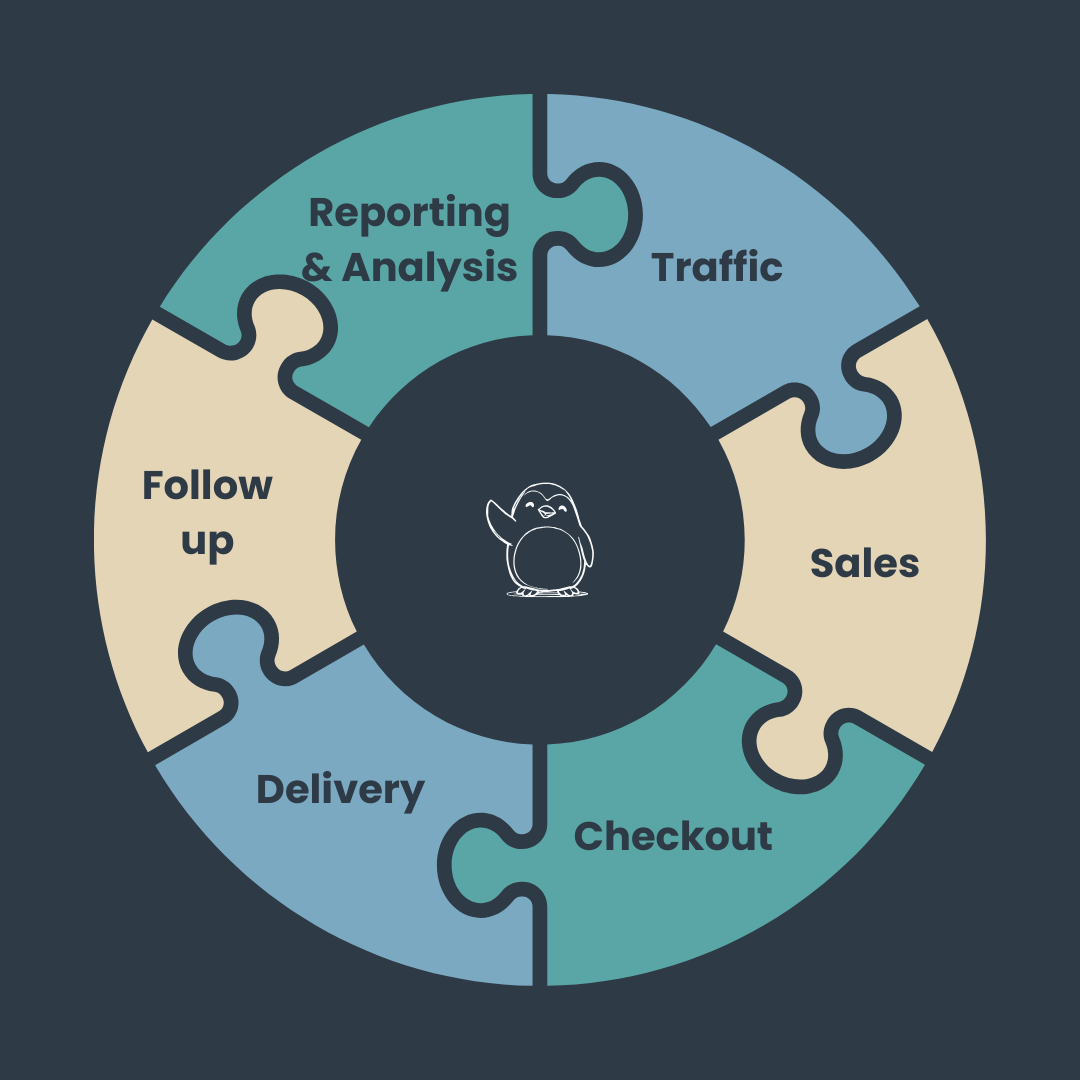
A funnel is not a single page or a single email. It is a connected system with distinct elements, each with a specific job to do. Understanding what those elements are and why each one matters is the foundation for understanding why a funnel built without proper strategy in place rarely performs the way it should.
Traffic
The people entering the funnel have to come from somewhere. Traffic is the source, social media content, blog posts, search results, paid advertising, referrals. Without traffic arriving at the entry point the rest of the funnel has nothing to work with. Traffic strategy is not separate from funnel strategy. It is part of it.
Sales
The point where a decision is invited. This is the sales page, the place where the right person, having moved through the earlier stages, is asked to take the next step. It has to be built on an accurate understanding of who is arriving there, what they already know, and what they need to feel confident enough to act.
Checkout
The checkout. Where a buyer who has decided to purchase completes the transaction.
This is one of the most consistently underestimated elements in any funnel and one of the most important to get right. At the point of payment, a potential client is at their most vulnerable. They have decided they want what is being offered. But that decision is fragile. The checkout experience, the reassurance above the payment button, the clarity about what is being purchased, the visible guarantee, the professional presentation of the page, determines whether someone who has already decided to buy actually completes the purchase. A checkout that does not make the client feel safe at that moment loses sales that were already won.
Delivery
How the product or service reaches the buyer after purchase. What lands in their inbox, what they receive access to, and how immediately and clearly the value of their decision is confirmed. A delivery process that is slow, unclear or generic undermines the trust built in every previous stage.
Follow-up
The automated sequences that run after someone takes an action, whether that action is opting in, purchasing, or leaving a checkout before completing a payment. Follow-up sequences are where the relationship continues. For buyers, they deliver value and naturally introduce the next step. For those who did not yet buy, they continue building trust and addressing the hesitation that prevented the decision.
Reporting and analysis
A funnel without data is a funnel running on assumption. When a funnel is actively managed, the data feeds directly back into the business. Open rates, click-through rates, opt-in rates, conversion rates, these figures tell you what is working, what is not, and where something needs attention. They also surface issues that can arise unexpectedly and sometimes without warning. A link breaks. An automation stops firing. A sequence triggers for the wrong audience. These things happen and some of them are outside direct control. Reporting and analysis are what catch them quickly rather than letting them run silently and cost conversions for weeks or months before anyone notices.
What types of funnel exist
Understanding which funnel your business needs right now, not eventually, not theoretically, but at your specific stage with your specific audience and your specific offer, is one of the most important strategic decisions in the entire process.
Whether you are looking to build a simple sales funnel as your first entry point or a full connected ecosystem, the type you start with should be determined by where your business is right now, not by what looks most impressive.
The lead magnet funnel
The most common starting point for service businesses. A free resource is offered in exchange for an email address. The person who opts in enters a nurture sequence. The nurture sequence builds trust and leads toward a first paid offer. This funnel type builds the email list, begins the relationship and creates a warm audience for every future offer without requiring a financial commitment at the entry point.
The self-liquidating offer funnel
A low-cost entry product is offered shortly after someone enters the ecosystem. The price is low enough that the decision is made quickly. The purpose is to identify buyers within the list early and, at the right price point, to cover the cost of acquiring the lead.
The webinar or workshop funnel
A free or low-cost live or recorded session is offered. Attendees receive genuine education and see the thinking behind the work before making any financial commitment. This funnel type builds trust effectively with a research-led audience who needs to see evidence of expertise before deciding.
The challenge funnel
A structured sequence of content, tasks or sessions that delivers progressive value and builds momentum toward a purchase decision. Challenge funnels create strong engagement and naturally generate urgency around the offer presented at the end.
The application funnel
For higher-ticket or done-for-you services where the relationship needs to be established before a price is confirmed. A sales page leads to an application. The application leads to a call. The call leads to a proposal. This is the right structure for services that cannot be fixed-priced without a discovery conversation.
The full funnel ecosystem
Not a single funnel but a connected system of multiple funnels working together. A lead magnet funnel brings people in. A self-liquidating offer identifies buyers early. Nurture sequences lead toward mid-tier services. Loyalty mechanisms move buyers through the pathway toward higher-ticket services over time. Every exit point from one funnel becomes an entry point to the next. A full funnel ecosystem is available to any client regardless of where they are in their business journey. Whether you are starting from scratch or adding to what is already in place, the scope is built around what your business actually needs right now.
Why strategy connects everything
A funnel is not a collection of pages and emails. It is a system, and a system requires strategy to function properly.
Every element of a properly built funnel needs to connect to the elements around it. The traffic source connects to the entry point. The entry point connects to the nurture sequence. The nurture sequence connects to the sales page. The sales page connects to the checkout. The checkout connects to the delivery and the follow-up. And all of it connects back to the business goals the funnel is designed to serve.
When those connections are deliberate and evidence-based the funnel works. When they are assumed or built from a template the gaps show up in the data, and they show up in the revenue.
Understanding how people make decisions, what builds trust over time and what creates hesitation at each stage is central to building a funnel that converts. My training through The Two Lauras covers the psychology behind how people engage with content on social media, and that understanding of audience behaviour informs how the entry points and content within a funnel are approached. Charlotte Wibberley's CPD-accredited Certified Launch and Funnel Strategist programme is where the funnel-specific strategy, build methodology and testing process were learned and developed in depth. Both inform the work.
A funnel also needs to be aligned to clear business goals and a correctly structured offer before any build begins. Building a funnel around an offer that has not been properly interrogated, or without a clear picture of what the funnel is designed to achieve, produces a technically functional system pointed at the wrong target. The build can be excellent. The conversion will still disappoint.
Why most small business funnels do not convert
This is the part most guides skip, because the honest answer does not sell software or templates.
The most common reason a small business funnel fails to convert is not the platform it is built on. The platform is a container. What goes inside it and the strategy connecting every element is where the problem almost always sits.
The offer itself may not be correctly structured. A funnel built around an offer without a clear value proposition, or one that does not lead naturally to the next step in the ecosystem, will not convert regardless of how well it is technically built.
The entry point may not be converting. When the people arriving at the opt-in page are not taking the step, something in the value proposition is not landing for someone encountering the business for the first time. This is almost always a message problem, not a design problem.
The nurture sequence may feel generic. When the emails that follow an opt-in could have been sent to anyone on the list rather than specifically to the person who opted in for this particular reason, trust does not build. The sales page that follows receives a cold audience regardless of how strong the copy is.
The checkout may have a trust problem. When the experience at the point of payment does not reassure the client that this is a safe and sensible decision, someone who had already decided to buy leaves. No visible guarantee, no clear summary of what is being purchased, nothing that confirms the professionalism and reliability of the business at the most important moment in the transaction.
The post-purchase sequence may be missing or incomplete. The moment after purchase is the moment a buyer is most open to the next logical step. A sequence that delivers the product and stops misses the most commercially important moment in the entire system.
Broken links and missing automations may be costing sales silently. A button that goes nowhere. A purchase that does not trigger a delivery email. A quiz result that fires the wrong sequence. An abandoned checkout with no recovery automation. These are invisible leaks that look like poor conversion but are technical failures, and they happen in every funnel that has not been tested properly end to end.
Most funnels are leaking in several of those places simultaneously. The ones built from a template rather than from a proper investigation of what the business actually needs have been leaking from the day they went live.
The free quiz identifies whether your foundations are solid enough for a funnel to convert before you invest in building one. Five minutes. Honest findings.
The cost of building it yourself
There is a version of this where you open a platform, find a tutorial and build something. The technology is accessible enough that constructing something functional is possible without professional support.
Here is what that version actually costs.
Do you know what technology a properly built funnel requires? Do you know how those tools connect to each other, what the integrations involve, and what happens when something in that chain breaks? Do you have the time to research the options thoroughly enough to make the right decisions, or could choosing the wrong technology become a costly mistake, financially, in the time spent learning it, or in the revenue lost while a non-converting system runs?
A sales funnel for small business template might seem like a way to build a sales funnel for free or at minimal cost. But a template is a structure without the strategy, the specificity or the testing that makes a structure convert for your particular audience. Building a sales funnel from scratch, building an online sales funnel that runs evergreen, or building a B2B sales funnel for a service-based business all require the same starting point. An accurate picture of the business, the audience, the offer and the goals before a single page is built or a single email is written. A template cannot give you that. It gives you a shape without the substance.
For an established service provider already managing client work and maintaining visibility, the time required to research, build and test a funnel properly is not spare. It comes from somewhere. Usually from delivery, from family, from the parts of the week that were already stretched. A funnel build handled alongside running a business does not progress in a straight line. It gets interrupted, deprioritised, returned to weeks later when the thinking that informed the early decisions has shifted. The result is a funnel built across months of fragmented attention, and that fragmentation tends to show in the structure.
Building systems and processes properly is something I understand from the inside. In my quality assurance work, the value of a properly built system was not theoretical. When every step was documented, every process was clear and every automation was in place, the team knew what was required, when it was required and what happened next without needing to ask. That is what a properly built funnel does for a business. It removes the constant decision-making, the manual follow-up and the anxiety of wondering whether anything fell through the gap.
You do not want to build a funnel wrong. You do not want to build it with the wrong person. Done incorrectly, a funnel is not just a wasted investment. It is a system that is actively failing your business every day it runs, often without you knowing exactly where or why. Getting it right the first time is the point.
What changes when the funnel is working

Imagine this.
You are on holiday. A proper holiday, not the kind where you are checking your phone every few hours, not the kind where you are half present with your family while the other half of your attention is on whether the business is still running without you. A real one. Your family has all of you, not the distracted, half-available version. You are rested. You are present. You are actually enjoying it.

Your phone shows a notification.
A sale has come in.
Not because you were there. Not because you followed up at the right moment or posted the right thing that morning. Because the system is doing what it was built to do. The right person found the business, moved through a process that built genuine trust at every stage, arrived at the offer when they were ready to decide, and made a purchase. The delivery, if it leads to work that requires your involvement, goes straight into your calendar for when you are back and available. No toing and froing. No panic about lost sales. No guilt about being away. The business is producing revenue because it has a system working for it, and that system does not require you to be on high alert for it to function.
That is not a fantasy version of business. It is what a properly built, properly tested, properly automated funnel produces.
Before it is in place, the business depends on you for everything. Every enquiry arrives because you showed up. Every sale happens because you were present at every stage of the conversation. The revenue is real but fragile. One quiet month, one period of illness, one season of reduced capacity and the pipeline slows, because the system that should be filling it was never properly built.
When the funnel is working, that changes structurally and the change is felt in every part of the business and beyond it.
Launches feel structured rather than exhausting because the sequencing and the follow-up are handled. The pipeline becomes predictable rather than dependent on how much you personally showed up that month. The decision about whether to take on another client is made from a position of commercial confidence rather than quiet anxiety about whether the next enquiry will arrive.
A properly running funnel also reflects the Four Pillars of Trust in how it operates. Consistency in how it shows up for your audience. Transparency in how it communicates. Accountability in how it delivers. Reliability in how it follows through. When those four things are embedded in every step of the funnel, in the emails, the sales page, the checkout, the delivery, the business looks and feels professional at every touchpoint, whether or not you are personally present.
What a strategy-led funnel build involves
Most funnel builders receive a brief and execute it. They build what they are asked to build. If the brief is based on assumption rather than evidence, the funnel reflects that assumption. It may function technically. It will not convert the way it should.
Before building The Efficient Penguin Co. I spent 12.5 years in professional investigation and evidence gathering, followed by 18 months in leadership and quality assurance in education. Alongside that I have spent more than two decades in customer facing roles across retail, security and cabin crew, on both sides of the trust equation, as the person responsible for the experience and as the customer living it. That combination gave me one consistent habit. Looking at what is actually there before recommending anything.
As a CPD-accredited Certified Launch and Funnel Strategist, my own lead magnet funnel was built using this methodology and submitted as my certification case study. The feedback from Charlotte Wibberley was this.
"This was really comprehensive, technically sound and just bloody amazing from start to finish. The level of thought, detail and implementation throughout was genuinely impressive. You did not just tick boxes. You built something strategic, cohesive and commercially strong and it absolutely shows."
That funnel is the same funnel at the entry point of this business. Built the same way every client funnel is built. Investigation first. Evidence-based decisions. A build that reflects the business accurately rather than what a brief assumed it needed.
Every engagement also includes a full visual funnel map, every step, every decision point, every email, every automation and every path through the funnel documented in a single reference. You leave with a complete picture of exactly what was built and how every element connects, so that every future decision about the funnel has an accurate foundation to work from.
How much does it cost to build a sales funnel
In the UK market the range is wide, from a single lead magnet funnel through to a full connected ecosystem built across multiple offers and audiences. Pricing for every engagement is confirmed following the discovery call, once the scope is clear and the strategy session has established what the business actually needs. There is no fixed price list because no two funnels are the same.
What the question does not account for is the cost of a funnel that does not work.
A funnel built without proper investigation of the offer and the audience, without the strategy connecting every element, without tested automations and end-to-end path testing will not produce the results you are looking for. The cost of rebuilding and the cost of the traffic and time that passed through a non-converting funnel while it ran is almost always higher than getting the strategy right before the build begins.
The more useful question is not how cheaply you can build a funnel. It is whether the funnel you build will do what you need it to do, and what it costs when it does not.

Two ways to take the next step
If you are not yet certain whether a funnel is the right next step for your business right now, the free quiz takes a few minutes, asks the questions worth sitting with honestly, and tells you which gap is most likely holding your results back right now. Most people find at least one thing they did not expect.
If you already know you need a funnel and want to explore what a strategy-led build would involve, applying to discuss your funnel is the next step. The discovery call is a focused conversation about your business, the funnel you need or the funnel you already have in place and want properly investigated and fixed. There is no cost and no obligation. By the end of the call you will know whether this is the right fit, what the engagement would involve and what comes next.
Apply to discuss your funnel here.
If you have a funnel already and you are concerned it is not converting the way it should, that is something I work on too. The investigation service reviews every element of an existing funnel against every leak point, identifies what is not working and why, implements the fixes and delivers a full report of what was found and what was changed. You do not have to start from scratch to get a funnel that works properly.
Apply to discuss your funnel here.
If you want to understand what a connected funnel ecosystem produces commercially for an established service provider the What Is Your Business Actually Missing Out On blog and the What Your Business Could Be Earning That It Currently Is Not blog show exactly that.