
What If You Already Knew Exactly What Was Working

An enquiry lands.
Someone wants to work with you. They found you on social media, they say. Something you posted made them feel like you understood their situation exactly and they had been thinking about reaching out ever since.
You feel the warmth of it. The quiet satisfaction of the work paying off. And then, underneath that, a question forms.
Which post was it.
Not out of idle curiosity. Because if you knew specifically what it was that made that person stop scrolling and decide you were the one they wanted to contact, you could do it again. And again. Not by accident. By design.
The hook that stopped them. The angle that made them feel seen. The format that carried the message further than anything else that went out that week. The specific combination of content decision and intention that turned a post into a client conversation. That information already exists somewhere in your feed. It has always been there. You just have never had a structured way to find it.
That is what changes when you run a proper content review for the first time.
Not sure whether your content is the main gap or whether something else needs attention first? The free quiz takes five minutes and tells you specifically where to focus.
Find out where your business stands.
And what you find when you do is almost never what you expected.
The discovery nobody tells you about
The post that is making you money is probably not the one you think it is.
It is almost certainly not the one you spent the most time on. It may not be the one that performed best on the platform. It is often the one you gave no particular thought to. The caption written in twenty minutes because the week was full. The format tried almost as an afterthought. The angle you were not sure about when it went out.
And here is the part that stops most people when it lands properly.
That post, the quick one, the one that cost you the least time and energy of anything you published that month, has been doing more commercial work than the posts you spent hours on. The ones you rewrote three times. The ones you agonised over the graphic for. The ones that felt like real effort when they went out.
It took twenty minutes. It generated an enquiry. Possibly more than one.
Which means the hours spent on everything else could have gone somewhere else entirely. Back into client delivery. Back into the business development conversation that has been waiting. Back into the evening that was supposed to finish at six. Back to the people waiting for you to be done with work.
That is not a small realisation. That is a significant one. Because once you know which content costs the least and returns the most, every decision about where to put your time becomes more accurate. You stop spending hours on formats that produce nothing and start investing that time into the ones the evidence shows are working. The content side of the business becomes more efficient not because you are trying harder but because you finally know where the effort belongs.
And then there is the other side of it
The post you were proud of that produced nothing.
The format you have been repeating for months because it felt strong, that the data shows stopped working some time ago. The content pillar you have been treating as central to what you do, that your audience has been consistently less moved by than the one you have been treating as secondary.
Finding that out stings for a moment. And then it is an enormous relief.
Because every hour spent on content that is not working is an hour that could have gone somewhere that is. Every decision made from assumption, when the evidence would have shown something different, has been quietly redirecting effort away from what would move the business forward.
Knowing what is not working is not a failure to sit with. It is data to act on. It frees up time, energy and creative capacity to go into what the evidence shows is actually earning its place. The next cycle of content becomes not just more intentional but more efficient. Less of what costs without returning. More of what compounds.
That is the exhale. Not just the excitement of discovering what is working. The relief of finally having the full picture. The quiet confidence of someone who knows specifically what their social media content plan is doing and why, rather than the low-level uncertainty that follows most service providers through their content indefinitely.
That smugness, the kind that comes from knowing what others in your industry are still guessing at, is entirely earned.
What the purpose of a content audit actually is
Most people who ask what is the purpose of a content audit expect the answer to involve analytics. Reach, impressions, follower growth. Numbers the platform already shows them.
A proper social media content audit goes considerably further than that. It asks not how a post performed within the platform but whether it performed for the business. Whether it moved the right person closer to making contact. Whether the time it cost was proportionate to the return it produced. Whether the decisions behind it were the right ones.
That is a different question from anything platform analytics answers. And the gap between what the platform shows and what a structured audit reveals is where the most commercially useful information sits.
If you want to understand what a structured social media content audit actually looks at before you run one, How to Do a Content Audit on Social Media covers this in full.
Understanding how to do a content audit properly, with consistent criteria applied to every post rather than a general impression of how the month went, is what turns a review from an interesting exercise into a decision-making tool. The structure is what creates the insight. Not the volume of posts reviewed.
If you want to know whether a content audit is the right starting point for your business right now, the free quiz gives you a scored result across five specific areas in five minutes.
What a social media content strategy plan actually looks like
Creating a social media plan that is genuinely connected to what the business is trying to achieve looks different from a content calendar with dates and post types filled in.
What should a social media plan include that most plans leave out is the commercial intention behind every piece of content before it is written. The specific business objective each post is serving. The audience need it is addressing. The buyer awareness stage of the person it is written for. The format chosen deliberately rather than by habit. The time estimated in advance so the cost is visible before the commitment is made.
A social media strategy planner built around those questions does not just keep the feed active. It gives every post a job to do and a way to measure whether it did it. That is the difference between a content strategy plan that produces a body of work and a content calendar that produces a feed.
If you want to understand why consistent posting and strategic content planning are two completely different things, Content Planner for Social Media: Stop Posting Without a Plan covers the distinction and what it costs when the two are treated as the same.
A content planner template built around commercial intention rather than scheduling slots is also what makes creating a social media plan genuinely useful for a service provider working alone rather than something that feels like extra administration on top of everything else the business already requires.
I built both of these tools on the same principle I applied across 12.5 years of professional investigation and evidence gathering, followed by 18 months in leadership and quality assurance in education. You do not draw conclusions until you have looked at what the evidence is actually showing you. You do not go on instinct when you have access to data. You structure the information first and then let it tell you what it needs to tell you. That is what both tools are built to do for the content side of your business.
What the system looks like in practice
At the end of each content cycle you open the Content Audit Template and work through what went out. Not a general sense of how it performed. A structured assessment, every post, the same 18 focused questions applied to each one consistently. Content pillar, format, message intent, buyer awareness stage, engagement, enquiries generated, how the post felt to create, and an honest overall assessment of whether it earned its place.
The number of posts reviewed depends entirely on posting frequency and which platforms are being used. Review one platform at a time in a dedicated base for a platform-specific picture. Review everything together for a cross-platform view. Work through 15 posts if that is what went out. Work through 60 if higher frequency posting means a richer picture is possible. Review every two months if that rhythm suits how the business runs better than monthly. The structure is what surfaces the patterns. More content sharpens the picture but even a smaller review will reveal things that have been invisible.
Duplicate the base to keep platforms separate or run everything together. Use it in whatever configuration fits how the content side of the business actually works.
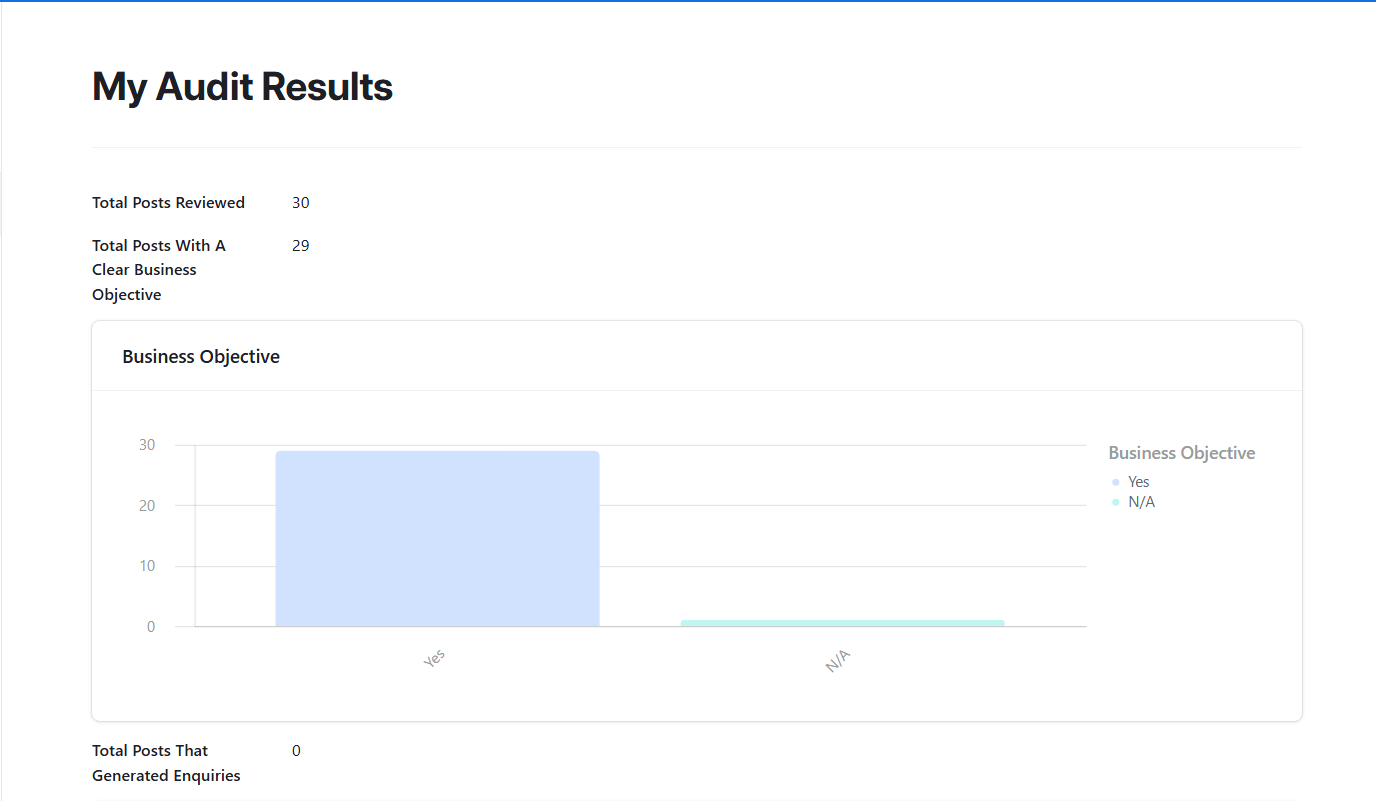
The summary table updates as the audit progresses. Once complete, the interface report gives bar charts and totals across every dimension of the full period reviewed. The patterns invisible post by post become unmistakable when the whole cycle is read as a single body of evidence.
Those findings go directly into the planning session.
The Strategic Content Planner is where that evidence becomes the next cycle of content. Every post mapped to a business objective before a word is written. Content pillar assigned. Audience need identified. Buyer awareness stage considered. Time estimated in advance. The decisions that currently happen reactively, in the gaps, under the weight of everything else the week contains, get made deliberately instead, in the context of what the full month needs to achieve.
The writing becomes the execution of decisions that are already made. Most people find the content itself takes significantly less time once the thinking has a proper home before the blank document opens. That time goes somewhere better. Into client delivery, into the business development conversation that has been waiting, into the evening that runs to a reasonable time for once.
Together the two tools form a complete content strategy for social media. One that plans with intention and reviews with evidence. Each cycle more accurate than the last because it is built on what the previous one actually showed. Each month the content side of the business running more efficiently than the month before because the data is showing exactly where the time belongs.
I built both tools to work as a pair because that is the only way either of them reaches its full value. The Strategic Content Planner without the audit builds on assumptions. The Content Audit Template without the planner surfaces evidence that has nowhere to go. Together they close both gaps and give the content side of the business the system it has been running without.
If you want the strategy designed around your specific business goals and offers rather than building it yourself, The Strategy Gap covers what consistent posting without strategic direction is actually costing and what the 90-Day Direction Plan does instead.

This works wherever you are starting from
For service providers who are new to structured content planning, these tools give a framework from the beginning. Rather than months of posting before starting to understand what is landing, the structure goes in from the first cycle. Plan with intention, review with evidence, and start learning what the audience responds to from the very start rather than working it out years later by instinct.
For established service providers who have been posting consistently for a while, the content archive already contains data that has never been properly read. The patterns are there. The formats that convert, the pillars that resonate, the hooks that move the right people. The audit surfaces them. The planner puts them to work.
The starting point is different. The system and the compounding effect it produces are exactly the same.
What is inside
The Strategic Content Planner gives you a pre-built Airtable social media content planner base with full business objective mapping, content pillar framework, audience need alignment, buyer awareness stage tracking, time estimation and reflection columns. A 36-page PDF guide walks through every element and why it exists. A video walkthrough shows the full system in action. An illustrated setup guide provides step-by-step screenshots so nothing needs to be figured out independently. No prior Airtable experience needed. Most people are using it within thirty minutes of purchase.
Total value £250. One payment of £49. Delivered immediately.
The Content Audit Template gives you a pre-built Airtable social media content audit base with pre-populated rows ready to go, a linked summary table that updates automatically as each post is worked through, and an interface report that visualises the full picture once the audit is complete. A step-by-step setup guide, a field-by-field completion guide covering exactly what each question is asking and why it matters, and a results interpretation guide explaining what the findings mean and what to do with them. Duplicate the base to keep platforms separate or run everything together across all platforms in one view.
Total value £250. One payment of £49. Delivered immediately.
The return on the investment
Two tools. A combined standalone value of £500. Available together for £66.
Purchase the Strategic Content Planner at £49 and add the Content Audit Template at checkout for £17 rather than £49. A saving of £32 on purchasing both at full price, and a saving of £434 against the total combined value of everything inside them.
But the financial case for these tools is not really about the purchase price. It is about what the system produces from the moment it is in place, and for as long as it is used.
Use both tools every month and the return compounds with every cycle. Each audit makes the next plan more accurate. Each plan gives the next audit more to surface. The content becomes more focused, more efficient and more commercially directed month by month without the investment increasing at all. The £66 paid once is the same £66 whether the tools are used for six months or six years.
Hand them to a VA or a member of staff to run and the return increases again. The audit does not require the service provider to complete it personally. The planner does not require the service provider to map every post. Once the system is set up and the process is understood, both tools can be handed to someone else to operate. The strategic thinking stays with the business owner. The administrative side of running the system does not have to. That is a meaningful shift in how the content side of the business operates and it costs nothing beyond the initial £66.
The content the system produces is also not a cost centre. It is a revenue mechanism. Every post that goes out with a clear business objective behind it, mapped to the right audience at the right stage of their thinking, is a post doing commercial work. The service provider who knows which format generates enquiries, which pillar builds the trust that converts, and which hook stops the right person mid-scroll is not spending time on content. They are investing it in a system that brings clients into the business.
The enquiry that landed because of the post that took twenty minutes. The client that came from it. The revenue that followed. That chain started with a piece of content. Knowing which piece, and why it worked, and how to produce more of them deliberately, is what these tools give you.
At £66 for a system that does that indefinitely, for as long as the business is creating content, the question is not whether it is worth it. The question is what the cost has been of not having it in place until now.

How to start
Purchase the Strategic Content Planner for £49 and add the Content Audit Template at checkout for £17. Both tools for £66 rather than £98 purchased separately, and £434 less than the combined standalone value of everything inside them.
If you have content already out there, run the audit first. Let it show what has been working before building the next plan. Bring the findings into the planner and build the first structured month on evidence rather than assumption.
If you are newer to structured content planning, open the planner, run a structured cycle with intention, then audit what that first intentional period produced. Bring both into the monthly rhythm from there.
If you want to understand the framework that determines whether your content builds trust over time or simply keeps the feed active, the Four Pillars of Trust blog explains why the foundations matter before the content strategy does.
If you want to know where your content sits within the wider picture of your business before starting, whether content is the most pressing gap or whether messaging or strategy needs attention first, the free quiz will show you specifically where to look. Most people find at least one thing they did not expect.