
Is It Worth Paying a Social Media Manager? An Honest Answer

You have built a business you are proud of. You show up. You post consistently. You put genuine thought into what you share and real time into getting it out there. And yet something is not adding up.
The effort is real. The return is not matching it. And somewhere between opening Canva on a Saturday morning and scheduling something that felt disconnected from everything else you are trying to achieve, you started wondering whether there is a better way to be spending that time.
Or perhaps you are not posting at all. You know you should be. You know the business needs the visibility. But the capacity to make it happen consistently simply is not there alongside everything else the business demands. You need someone to take it off your plate entirely and run with it properly.
Or perhaps the question is simpler than either of those. You are not sure whether what you have been doing is working. The enquiries are inconsistent. The content goes out but the connection between it and your commercial goals has never been clearly made. Something is not adding up and you need someone who can find out what it actually is before you invest any further in activity that may not be solving the right problem.
Three different positions. The same question underneath all of them. Is it worth paying a social media manager.
Before answering that question it helps to know which gap you actually have. The free quiz takes five minutes and tells you specifically whether your gap is capacity, strategy or something else entirely.
Find out where your business stands.
It is a good question. It deserves more than a sales pitch dressed up as an answer.
So here is an honest one.
The bucket with a leak
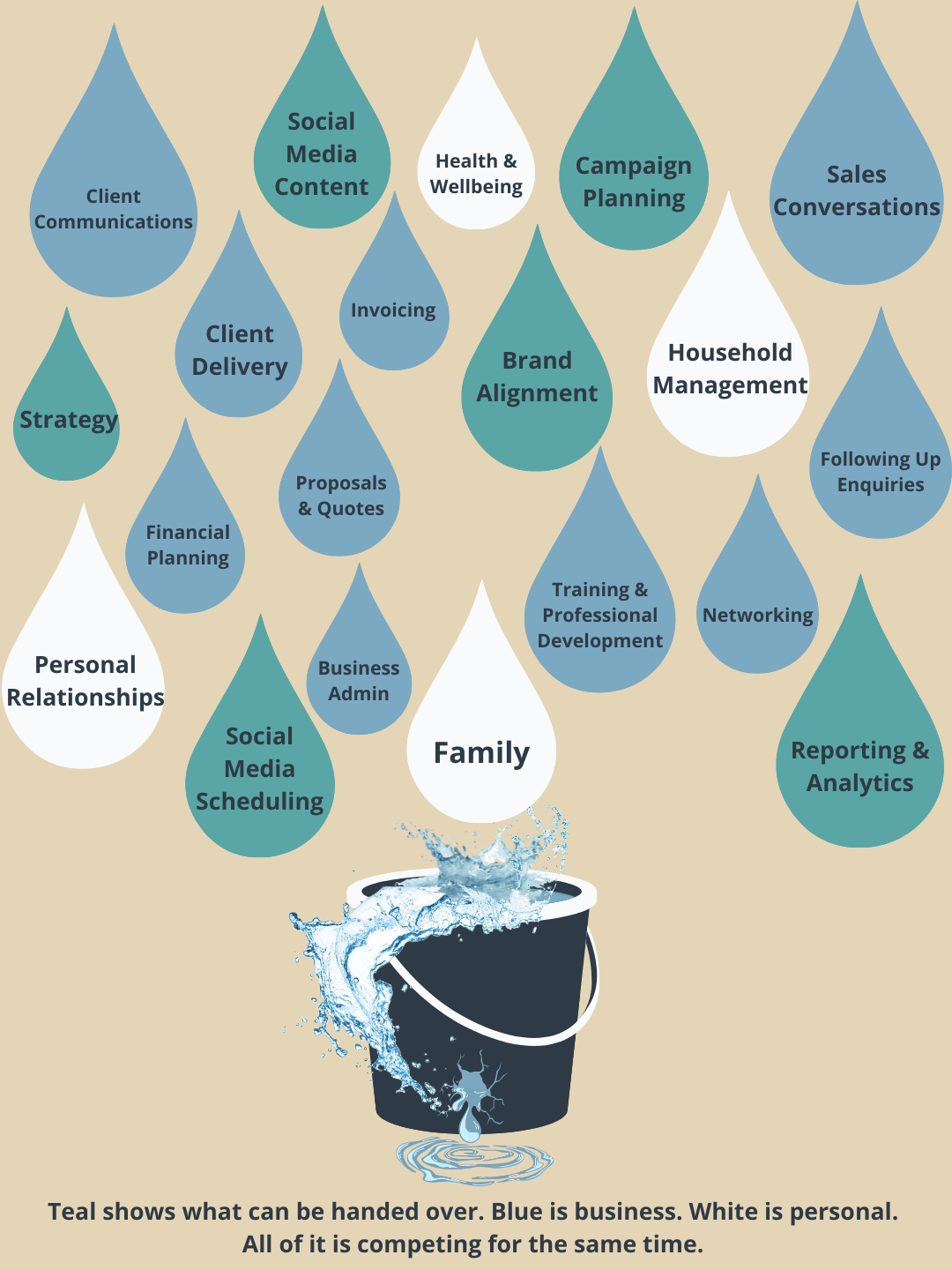
Think about your marketing effort as water going into a bucket. You are filling it consistently. Content goes out, time is invested, energy is spent. But if the bucket has a leak it does not matter how much water you pour in. The level never rises the way it should. The effort disappears at the same rate it goes in and the results never reflect the work behind them.
For most established service providers that leak is not a lack of effort. It is the absence of commercial structure behind the activity.
The content goes out. But it is not connected to your offers. The posting happens. But the strategy behind it exists only in your head, shifting slightly week to week depending on what feels right that day. Enquiries come in occasionally, from people who seem right, but inconsistently enough that you cannot identify what is driving them or how to get more of them.
The pattern that emerges most consistently when established service providers talk honestly about this problem is that most of what fills the bucket is not complex work. It is repetitive, unstructured activity that has never been properly systemised. The overflow is not purely a capacity problem. It is a structure problem. When the recurring tasks run on a proper system the bucket stops refilling as fast.
The capacity and the structure are connected. Carrying the execution without a system behind it creates the capacity problem. Fix the structure and the capacity question changes shape entirely.
That is not a social media problem. That is a foundations problem. And it is the most important distinction to understand before you decide what kind of support you actually need.
The free quiz identifies whether you have a structure problem, a capacity problem or something else driving the gap. Five minutes. Specific findings.

What a social media manager actually does
Before you can decide whether hiring one is worth it you need a clear picture of what you are actually buying. Because not all social media management is the same and the gap between the two versions matters enormously to the outcome.
At the most basic level a social media manager handles the execution. Content is created, scheduled and posted on your behalf. That takes the task off your plate. It stops the Saturday morning Canva sessions. It means something goes out even when you are deep in client work or simply too stretched to find the words.
At a strategic level the work is fundamentally different. It starts with understanding your business goals, your positioning and your audience properly. Content is mapped to your commercial priorities and your offers. Campaigns are planned around what you are selling rather than posted reactively when you remember something needs promoting. Analytics are reviewed and acted on rather than collected and glanced at. Every decision about what goes out is grounded in evidence rather than instinct.
That second version is also significantly more time consuming than most business owners realise when they are doing it themselves. Done properly, strategic social media management involves monthly strategy, campaign planning, content creation, scheduling, accessibility integration, analytics review and ongoing reporting. When you are carrying all of that alongside client delivery, business development, financial management and everything else competing for the same finite hours, something gives. Usually the quality of the thinking behind the content. Sometimes the consistency of it. Always the time you had hoped to spend on the parts of your life that are not your business.
There is a reason hiring a cleaner makes sense when your time is worth more spent elsewhere. You could clean the house. You are capable of cleaning the house. But the hours it takes are hours taken from the work only you can do, and from the family and the life you built the business to support in the first place. The same logic applies here. The question is not whether you are capable of managing your social media. The question is whether it is the best use of what your time is actually worth.
What strategic ownership actually looks like
I want to tell you about an experience I had recently that has nothing to do with social media and everything to do with what genuine strategic ownership of a customer experience actually looks like.
My family and I flew to Scotland for a weekend break. We had planned the trip carefully around my daughter's school schedule, travelling Friday evening and returning Sunday, two full days in Scotland with the time we had available.
We were at the airport when the announcement came. The flight to Aberdeen had been cancelled. All passengers to report to passenger services.
The immediate picture was clear. A hotel for the night. A Sunday flight rebooked from the available schedule. The trip we had planned carefully around school and work would not have been possible at all. We were due to fly home on Sunday. A Friday cancellation with a Sunday rebook meant no trip. The weekend was gone before it had started. I went to find out what the options were while my family finished dinner and I came back with news nobody wanted to hear.
And then something happened that I had never seen before and did not expect to see.
The captain of a Birmingham flight agreed to reroute. He would fly his passengers to Bristol first, collect the Aberdeen passengers, and then continue to Scotland. A solution that should not have been possible. New flight paperwork filed. Fuel recalculated. Take off and landing slots renegotiated with air traffic control around existing flights. Birmingham passengers taken in the wrong direction before going in the right one. The commercial cost to the airline of the alternative, refunds and hotel accommodation for twenty to thirty passengers at the price we had paid, was considerable. The solution cost more in operational complexity than cancelling outright would have.
They chose the solution anyway.
There would have been unhappy passengers on that flight. It would be unrealistic to suggest otherwise. But not one person displayed it. The way the situation was handled, the solution found, the communication given, absorbed what could easily have become a very difficult Friday evening at an airport and turned it into something else entirely. We went. The trip happened. My daughter got her two days in Scotland.
When we landed late that night a car hire company was waiting. A different business entirely. No connection to the airline. But the woman behind the desk had stayed past closing time to hand us the keys. Everything was ready. She was sorry we had had such a delayed journey. She made the handover as smooth as it could possibly be at that hour with a tired child.
Two businesses. One significant crisis. One smaller act of going beyond what was required. Both making the same choice. The customer experience was protected because the right people with the right systems made decisions based on what the customer needed rather than what was operationally convenient.
That is what strategic ownership of a customer relationship looks like. And it is the standard that separates a business that handles social media as a task from one that manages it as a commercial asset.
When social media management is done properly the content that goes out is not produced because the schedule says something is due. It is produced because it serves the business goals, reaches the right people and reflects the positioning that has been carefully built. When something shifts, when an offer changes or a campaign needs adjusting or an opportunity appears, the response is not to post reactively and hope for the best. It is to assess what the business actually needs and act on that evidence. The same discipline the airline applied on a Friday evening when the easier option was available and they chose the harder one instead.
That is what you are buying when you invest in strategic social media management. Not posts. Strategic ownership of the most visible part of your business, delivered by someone who understands that the standard either holds or it does not, and that there is no halfway point between the two.
Where I come in
Before building The Efficient Penguin Co. I spent 12.5 years in professional investigation and evidence gathering, followed by 18 months in leadership and quality assurance in education. Alongside that I have spent more than two decades in customer facing roles across retail, security and cabin crew, on both sides of the trust equation, as the person responsible for the experience and as the customer living it. That combination gave me one consistent habit. Looking at what is actually there before recommending anything, following the evidence, and being honest about what I find whether or not it is what someone hoped to hear.
That background is directly relevant to how I approach social media management. Investigation before recommendation. Evidence before action. A commercial standard that either holds or it does not. Every client I work with receives the same level of strategic rigour behind their content that the airline applied to that Friday evening flight. Not because the situation demands it. Because that is the only standard worth operating to.
Where messaging is not consistent that is not a reason to walk away from social media management. It is a reason to address it properly within the engagement rather than leave it running disconnected. A business cannot keep communicating inconsistently and expect the right results. The management process addresses what needs addressing so the content that goes out is built on something solid rather than something that has been drifting.
What social media management actually costs in the UK
This is the part most providers skip over. Pricing pages stay vague, packages are hidden behind enquiry forms, and the business owner trying to make a sensible decision is left researching in the dark. That approach does not serve anyone well.
So here is a transparent picture of what social media management costs for service providers in the UK, what drives the difference between the lower and higher ends of the market, and why comparing the cost of outsourcing to the cost of employing a social media manager is worth doing properly before making any decision.
Freelance social media managers in the UK typically charge anywhere from £300 to £800 per month at the entry level. At that price point you are generally buying execution. Content is created and scheduled. Posting happens consistently. The task is covered.
Mid-level social media management, where strategy is genuinely integrated into the work, typically sits between £800 and £2,000 per month at fixed package rates. At this level the social media is being managed as a commercial asset rather than a content production task. The limitation of fixed packages is that they are designed around an average business rather than yours specifically. The number of platforms, the complexity of your offers, the depth of strategy required and the level of reporting that actually serves your business all vary. A fixed package absorbs none of that variation. You pay for what the package includes, whether or not it is what your business actually needs.
At the consultancy end of the market, fully tailored social media management is structured differently. At The Efficient Penguin Co. onboarding begins with a fixed month at £2,000. This is not an admin process. It is the investigative and strategic foundation that makes every month of management that follows commercially purposeful. Monthly management follows from month two, starting from £1,500 per month with the final investment confirmed following a discovery call and built specifically around your business, your platforms and your goals. You pay for what is right for your situation, not a fixed package designed for someone else.
What drives the difference in social media management pricing is not primarily the number of posts. It is the depth of strategic thinking behind them, the rigour of the onboarding process, the level of commercial accountability built into the relationship, and whether the person managing your social media is treating it as a task to complete or a commercial asset to build alongside you.
Cheap social media management exists. It is also the version most likely to produce the experience of paying for something that did not work, not because the person was wrong but because the structure behind the activity was not there. The posting happened. The strategy did not.

The real cost of employing a social media manager instead
For an established service provider at six figures and looking to expand, bringing a social media manager in-house is a genuine consideration. Before that decision is made it is worth understanding what employment actually costs in the UK, because the headline salary figure and the real cost are two very different numbers.
Employer National Insurance sits at 15% on earnings above the £5,000 secondary threshold. This is one of the most significant and least visible costs of taking on an employee and it rises proportionally with every pay increase.
Auto-enrolment pension contributions sit at a minimum of 3% of qualifying earnings between £6,240 and £50,270. Again this rises with salary and is a cost that continues for as long as the employment does.
Statutory holiday pay covers 28 days minimum including bank holidays. This is built into the employment relationship from day one regardless of how the business is performing.
Statutory sick pay sits at £116.75 per week and is your liability from day one. A long term sickness absence can run for months before any practical recourse is available. For a growing business that needs reliable consistent delivery that risk is not a small consideration.
Recruitment costs through an agency typically run to 15 to 20% of first year salary. Advertising, interviewing and onboarding time add further cost even if you recruit directly.
Equipment including laptop, monitor and peripherals is your responsibility as the employer. Software and tool subscriptions for scheduling platforms, design tools and analytics software are costs you carry on top of the salary.
Training and professional development is increasingly expected by competent hires and without it their skills date quickly in an industry that moves as fast as social media.
Employee Assistance Programme and mental health and wellbeing support are increasingly expected at this business level and represent a genuine ongoing cost.
Life assurance, typically 2x to 4x salary, is expected by experienced hires. Employer liability insurance is a legal requirement the moment you take on an employee in the UK. Minimum £5 million cover is mandatory and typically adds £300 to £500 per year to existing policy costs.
Legal costs for employment contracts, disciplinary procedures, data processing agreements and HR compliance do not draft themselves. A specialist employment solicitor typically charges £150 to £300 per hour. Getting the paperwork right from day one is considerably cheaper than resolving a dispute later.
And then there is the management overhead of having a direct report. Your time, every week, without exception. And the reality that employment law does not favour the employer when things go wrong. A performance management process takes time, documentation and in many cases legal advice before it reaches a conclusion.
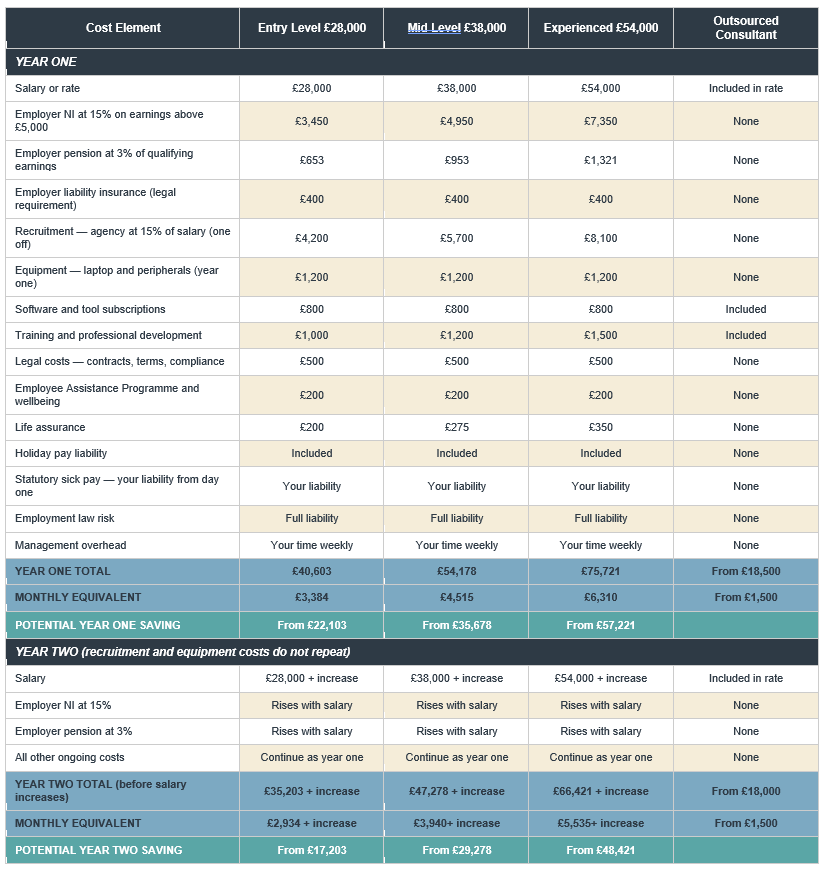
Employing versus outsourcing. Illustrative cost comparison
The figures below are illustrative and based on typical costs for a UK-based social media manager across three experience levels. Your actual figures will vary depending on the salary offered, the benefits package and the recruitment route taken. Employee salary figures do not include annual pay increases which typically run at 3 to 5% per year. Each increase raises the employer National Insurance and pension liability proportionally. The consultant column reflects The Efficient Penguin Co. pricing structure specifically. Other consultants will have different structures and rates.
What the monthly management rate actually covers
When a social media management consultant quotes a monthly rate that figure is carrying considerably more weight than it appears to. Understanding what sits behind it explains why the rate is what it is and why comparing it directly to an employee salary misses most of the picture.
A social media management consultant operating as a limited company in the UK carries the following costs before a single hour of client work is delivered.
Technology and tools represent the largest single overhead most consultants carry before client work begins. Every client's content is created, scheduled, managed and reported on using professional platforms. That means a CRM and automation platform, scheduling software, design tools, AI research tools, cloud storage, collaboration platforms, password management and data backup. For a consultant without an all-in-one platform covering multiple functions, technology costs can run to £400 to £600 per month before a single piece of client work begins.
Professional insurances including professional indemnity insurance, public liability insurance and cyber liability insurance are carried by the consultant, not the client. They are the professional standard that protects both parties and they represent a real annual cost that does not appear anywhere on the client's books.
Legal costs for client contracts, terms of sale, privacy policies, data processing agreements and ongoing legal review are costs the consultant carries entirely. A specialist solicitor drafting or reviewing business documents typically charges £150 to £300 per hour. Getting these right from the outset is a genuine investment in operating professionally and protecting both the consultant and every client they work with.
Accountant and bookkeeping costs for running a limited company require proper financial management. A qualified accountant handling annual accounts, corporation tax returns and ongoing bookkeeping is a compliance requirement. Annual accountancy costs for a small limited company typically run to £1,500 to £5,000 per year depending on the complexity of the business.
Business infrastructure including domain, website, business email, telephone and all the administrative infrastructure of running a professional business adds to the overhead before any client work begins.
Continuing professional development represents a significant ongoing commitment in an industry that moves as fast as social media. The expertise behind a properly delivered social media management service does not come free and does not stay current without active investment.
Corporation tax at 19% is paid on profits before income is taken as a limited company director. There is no employer contributing to a pension. There is no sick pay. There are no employment rights. Every day off is a day of unpaid lost revenue. Every period of illness is absorbed entirely by the business.
None of these costs appear on the client's books. None of them require the client's time or management. When a client invests in social media management they are not paying for posts. They are investing in the full professional infrastructure, the strategic depth and the genuine commercial partnership that sits behind every piece of content that goes out on their behalf. That is what makes the difference between a task being handled and a commercial asset being built.
The question underneath the question
When established service providers ask whether it is worth paying a social media manager they are usually asking one of three different things.
The first is a capacity question. They are doing their own social media, it is consuming time that belongs elsewhere, and they are ready to hand it over. The thinking is reasonably solid. The positioning is consistent. The content reflects the business well enough. The problem is not the strategy. It is that they are the one executing it when they should not be.
The second is an execution question. They are not posting at all or not posting consistently. They know the business needs the visibility. But the capacity simply is not there. They do not need to think about what to post. They need someone to take the whole thing and run with it properly.
The third is a strategy question. They are posting consistently but it is not connected to anything. Enquiries are unpredictable. They are not sure whether the problem is what they are posting, how often they are posting or something deeper. They feel the leak in the bucket but they cannot find where it is coming from.
These are different problems. They need different starting points. And confusing them is where the wasted investment happens.
The search terms people use when they are at this decision point tell their own story. Whether the gap is capacity, execution or strategy the question underneath is almost always the same one. Is what I have built strong enough to grow from here. That question deserves an honest answer before any investment is made.
When paying a social media manager is worth it
If the capacity gap or the execution gap is the real problem, your messaging is broadly consistent, your content reflects your positioning and the people you want to reach, and the issue is simply that you are the one doing all of it when you could be doing something else, or not doing it at all when the business needs you to be visible, then yes. Strategic management takes that weight off and maintains or builds the momentum your business needs.
The shift when it works is structural. The month no longer starts with the weight of what you are going to post sitting somewhere at the back of your mind. Content goes out consistently, aligned to your commercial priorities, without you having to find the time, find the words or find the energy for it alongside everything else.
The enquiries that come in are from people who have already read enough to know exactly what you offer and why they want to talk to you specifically. The conversation starts at a different level because the presence has already done the qualifying work.
That is what strategic social media management actually delivers when the foundations are right. The shift is not immediate. It is measurable, consistent and the kind that holds.
When it is not the right next step
If the strategy gap is the real problem, if you are not sure your messaging is landing, if your content feels completely disconnected from what your business is actually trying to achieve, if you cannot clearly identify what is driving the enquiries you do get, then hiring someone to post more of the same will not help.
Visibility amplifies whatever is already there. If the foundations are not solid, more activity surfaces that fact more quickly.
Where messaging needs work that is not a reason to avoid social media management. It is a reason to make sure the management engagement addresses it properly rather than building on something that is still drifting. The right engagement fixes what needs fixing before the content strategy is built on top of it. The wrong engagement posts over it and hopes for the best.
If the misalignment runs deeper, if the brand positioning, the messaging foundations and the audience definition all need significant work before any content strategy can be built effectively, that is where a Brand Alignment Audit and Brand Foundations Blueprint become the right starting point. Building on foundations that have not been properly reviewed produces the same inconsistency more expensively.
The middle ground most service providers do not know exists
Social media support is typically sold as a binary choice. Do it yourself or hand it over. But for an established service provider who has been managing their own social media for a while and is starting to wonder whether the effort is pointed in the right direction, neither of those options is quite right.
What that person often needs first is a clear social media strategy structured, documented and mapped to their actual commercial goals. Not someone to post for them. A 90-day strategic direction that connects their social media activity to their offers and their capacity, and gives them something concrete to work from, whether they implement it themselves, hand it to someone helping with their content, or use it as the brief when they are ready to bring in full management.
This is a strategy-only engagement. The output is direction, not ongoing execution. And for a significant proportion of service providers currently asking whether a social media manager is worth it, it is the more useful starting point. It is also considerably lower risk. A defined investment that produces a documented plan rather than a monthly commitment before the foundations have been confirmed as solid.
What changes when the right support is in place
There is a version of this that goes beyond the cost comparison.
It is the version that established service providers who are also running a household and raising a family will recognise immediately. The one where the business does not stay at the desk. It comes to the dinner table, to the school run, to the Saturday morning sports match. Not because the work is not important but because there is no system holding it in place, and without a system it expands to fill every available moment including the ones that were never supposed to belong to it.
The cost is not just time. It is presence. And the ripple reaches further than most people name out loud. The missed evenings. The distracted weekends. The family presence that quietly disappears not because you chose work over them but because the work had nowhere else to go.
When the right structure is in place that ripple stops. The content goes out. The strategy is held. The business is visible. And the hours that were spent filling a leaking bucket with more water become available for the work that only you can do and the life you built the business to support.
That is what the right support actually gives back. Not just hours. Presence.
But the right support depends entirely on which gap you actually have. And the most commercially sensible first step before committing to anything is finding out where the leak actually is.
The free quiz takes five minutes and gives you a specific scored result identifying whether your gap is capacity, strategy or both, and points you toward the right starting point for where your business actually is right now. Most people find at least one thing they did not expect.
If you are already clear on your gap and want to understand what the right level of support looks like, find out more about the 90-Day Direction Plan and Social Media Management here.